Published on February 13, 2026
Since the launch of Alto’s public consultation process, one thing has been clear: people want to understand the project, be heard, and get answers to all their questions—even the difficult ones. And that’s exactly what Alto has committed to doing.
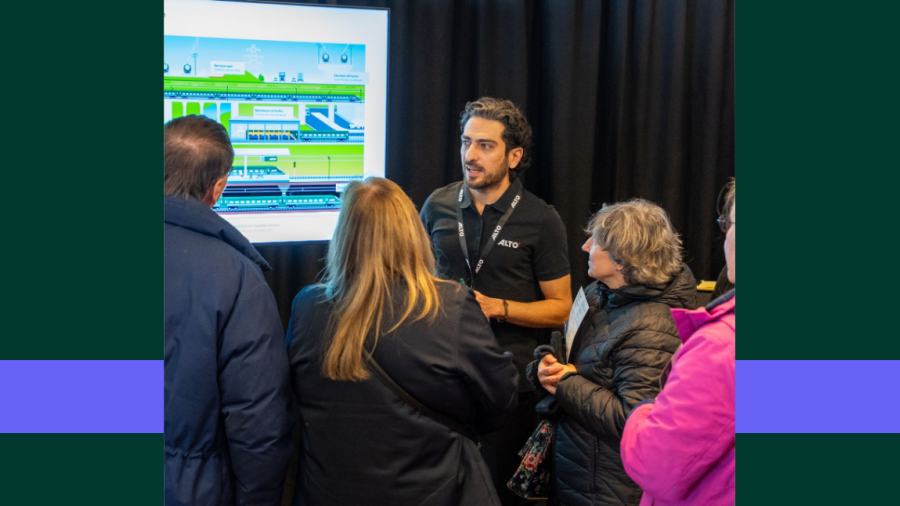
Through virtual meetings, roundtable discussions, and in‑person open house events, conversations have continued, deepened, and at times become more complex. That’s to be expected. A project of such magnitude as a high‑speed rail network naturally gives rise to expectations, questions, and perspectives shaped by local realities. For us, these conversations are an essential part of a genuine public consultation process.
Building on our first blog post, we are continuing the conversation by revisiting some of the questions we hear most often. The objective remains the same: to take stock, provide a channel for feedback, and share clear, honest, and accessible information to support an open and constructive dialogue with the public.
Why is a station planned in Laval when a stop is planned in Montréal as well, and how does it fit within the broader transportation network in the Greater Montréal area?
Laval is the third-largest city in Québec and benefits from a substantial base of users and workforce, supported by steady population growth and strong regional economic ties. Located between Montréal and Ottawa, Laval serves as a gateway to Montréal’s North Shore, which includes rapidly growing municipalities such as Terrebonne, Sainte‑Thérèse, and Saint‑Eustache. Laval is one of the seven cities designated by the Government of Canada, in the initial mandate given to Alto, to host a station.
How will property acquisition work, including expropriation if needed—and what does fair treatment mean in practice?
Alto’s priority is to minimize impacts on private property by following existing corridors—such as highways, railways, utility corridors, and lot lines—whenever possible. Since no route has been selected yet, it is not possible at this stage to determine which properties may be affected. Once an alignment is defined, we will be able to clearly identify the properties that could be involved.
Alto is committed to an owner-centred approach that prioritizes open dialogue and negotiated agreements with property owners. Where property rights are required for the project, owners will be compensated at market value for the property being acquired, as well as for potential losses and reasonable third-party fees incurred. As part of a fair and equitable acquisition process, Alto will conduct formal appraisals and consider a range of factors when determining a final settlement offer, including the physical condition of the property and any renovations or improvements that have been made.
How will Alto protect sensitive ecosystems, wildlife corridors, and protected areas along the proposed routes?
Minimizing environmental impacts is central to Alto’s approach. At this stage, Alto has identified a broad study corridor—not a final route—to allow teams to examine different options, conduct field studies, and document existing environmental and social conditions. These studies establish a solid baseline that informs technical design decisions.
The information collected, combined with technical expertise, Indigenous knowledge, and public input, guides avoidance, mitigation and, where required, compensation measures. This may include solutions such as wildlife crossings to maintain ecological connectivity, where appropriate.
The project will also be subject to a federal impact assessment that will rigorously evaluate environmental effects and mitigation measures before any final alignment is approved.
What can people expect in terms of noise, and quality-of-life impacts along the corridor?
Noise and vibration levels depend on factors such as location, train speed, and technology. As a result, impacts can differ from one area to another, and it is still too early to be specific about them.
Field studies are underway to establish baseline noise levels, and additional data will be collected as route selection progresses. Alto will work with Cadence and engineers to design mitigation measures adapted to each context, such as welded rail, noise barriers, or vibration reduction systems, with the goal of meeting or exceeding regulatory requirements.
Alto is also committed to working with communities to identify potential impacts and address them through design and mitigation.
What can Alto share about ticket pricing, pricing models, and affordability for future users?
It is still too early to provide specific details on ticket prices, as the route has not yet been established and the service offering is still being developed. That said, affordability is a core part of Alto’s mandate. The proposed fare structure will ensure the service remains competitive with existing options, such as driving, air travel, and conventional rail.
Alto is exploring different approaches, including various fare categories, a range of service levels—such as economy and business class—and targeted discounts for certain groups to reflect diverse travel needs and customer profiles.
Like most airlines and high-speed rail operators around the world, Alto plans to use revenue management to match fares with demand and available seats. The objective is to maximize seat occupancy and ridership on each train to operate trains as full as possible.
Details regarding fare structures and price levels will be refined as the project moves forward.
Keeping the conversation going
The conversation continues—both on the ground and here on the blog. In the coming weeks, our consultation activities will continue across the study corridor, and we will remain attentive to all questions, comments, and concerns shared.
We encourage you to check the Alto blog regularly to learn more about the questions and answers most often raised and share your views through our online consultation platform.
Share this blog post
Subscribe to the blog RSS feed