

A faster, more enjoyable way to connect cities
Alto’s vision is to build a network that revolutionizes mobility in Canada. The high-speed rail project will allow people to travel from one city to another in roughly half the time it currently takes with conventional rail services, offering a competitive transportation alternative to air and car travel, even allowing for same-day commutes.

| Route | Travel Time |
|---|---|
| Toronto—Ottawa | ~2h |
| Toronto—Montréal | ~3h |
| Ottawa—Montréal | ~1h |
| Montréal—Québec City | ~1h30 |
These time savings will improve intercity connectivity and create new opportunities for work, education and leisure. The high frequency of departures—estimated every 30 minutes during peak periods, depending on the route—along with schedules tailored to travel needs will provide great flexibility for passengers. For example, based on the current planning for the Montréal–Toronto route, 20 to 30 departures are expected each day.
Alto promises a seamless reservation experience: online or on-site booking, affordable fares adjusted to needs, and personalized options for solo travellers, families, or business trips. A one-stop customer service hub and intuitive features will simplify each step, while ensuring personalized support.
Stations that move people and communities
Alto stations will be designed as extensions of living environments, whether they consist of new builds or are integrated into existing infrastructure. Their design will integrate seamlessly into the urban fabric and they will offer the level of service expected in each chosen city. The stations will reflect the communities’ identity and incorporate local and Indigenous art. Their architecture will help enrich the travel experience.
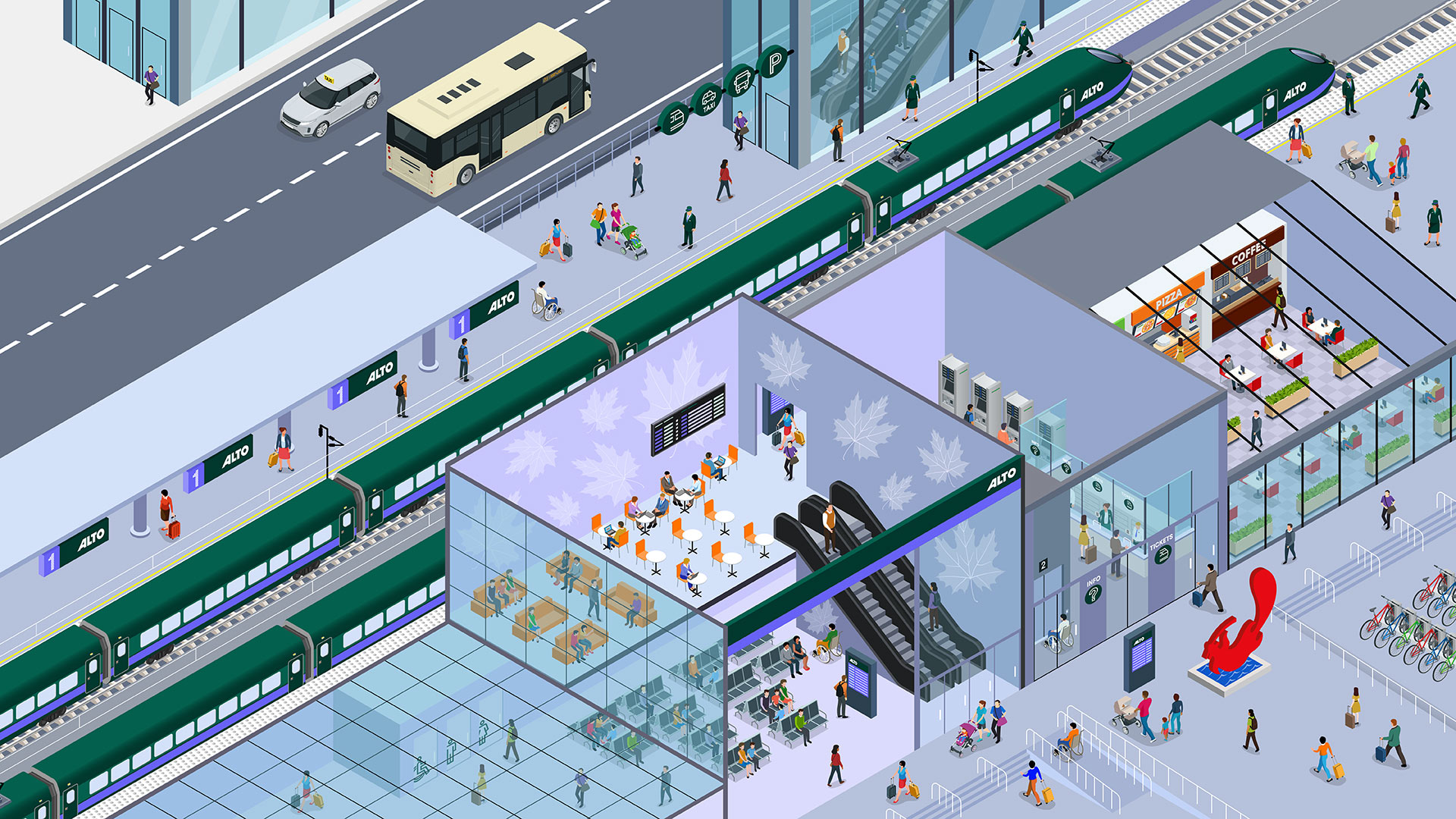
Our stations will become drivers of development:
- Urban integration: a strategic location for carefully planned urban development and diversified housing, including affordable housing.
- Economic activity: job creation and development of mixed environments (businesses, offices, community spaces).
- Sustainable mobility: connection to existing networks (buses, subways, bicycle paths, carpooling, etc.) and facilities that promote seamless transfer between transportation modes.
Accessibility and comfort
The design will be centred on universal accessibility: ramps, elevators, suitable signage, rest areas and assistance. Boarding and disembarking platforms will be designed to provide safety and accessibility for everyone. Safety measures will include uniform lighting, unobstructed spaces and rapid-response devices.
The stations will provide convenient services and optimal comfort: ergonomic furniture, efficient Wi-Fi, work areas, shops and restaurants. A sustainable approach will be used for their design: local materials, efficient energy and waste management, climate resilience and green spaces.
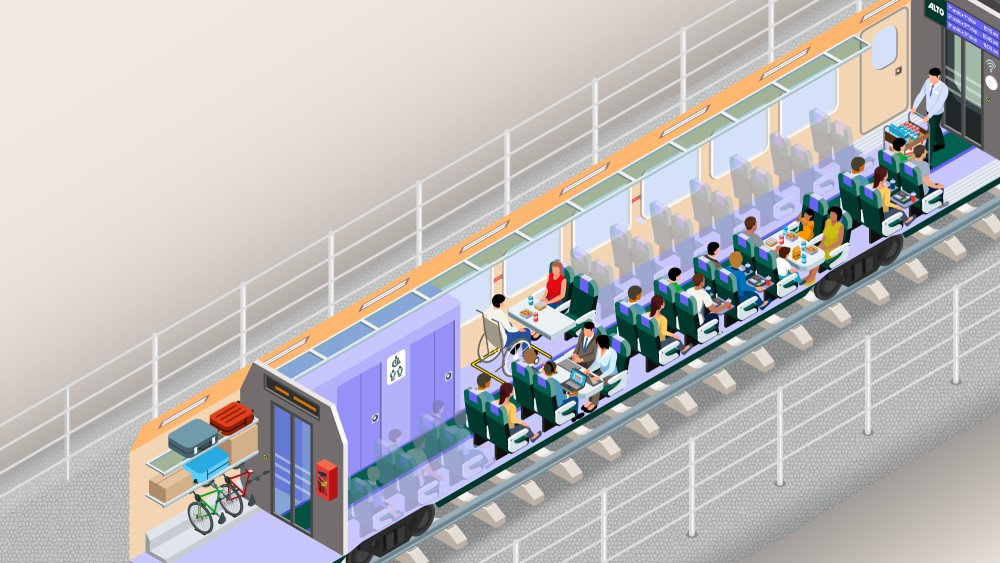
Network centred on accessibility and inclusion
- Spaces for travellers with reduced mobility
- Spacious aisles, accessible doors and washrooms
- Grouped seating and family areas
- Connected spaces for business travellers
Practical, customized services
- Fast Wi-Fi and device charging outlets
- Adequately spaced out washrooms
- Varied food services tailored to individual preferences
- Air quality and temperature control
- Real-time information displays and announcements
- Adjustable lighting and noise reduction devices
A network designed for Canadian weather conditions
The Alto network will be designed to deal with Canadian weather challenges, including harsh winters and extreme heat, as well as the impacts of climate change. Our teams will leverage innovative strategies and be mobilized to ensure service performance and reliability, even during the most demanding weather events.
Learn more about how our trains will be ready to face winter conditions.
