Published on July 31, 2026
Updated on September 14, 2026
Right now, we are in the development and pre-construction phase of our high-speed rail project, working to narrow our wider study corridor down to the final train route. To help bring communities closer together and transform mobility across the Toronto–Québec City corridor, we will be building a new railway that will cross through natural environments, farms, towns, and cities.
Every day, and with every step, we ask: how can we deliver a major infrastructure project while protecting the natural and human environments it will pass through?
We know that building a new railway creates pressures on the landscapes and communities along its route. That's why environmental planning is built into every stage of the project, helping us understand potential impacts and make informed decisions before construction begins. For an infrastructure project of this magnitude, a range of sensitive environments must be considered including agricultural lands, wildlife habitats, wetlands, and communities, including cultural features, heritage sites, and areas of importance to Indigenous peoples and nations.
To guide those decisions, Alto follows an established and structured approach: avoid, mitigate, compensate. While planning and building, our first and most preferred option is to avoid causing negative impacts. Despite our best efforts, however, some impacts are unavoidable. Where we cannot avoid impacts, we aim to reduce and mitigate effects as much as possible. And in rare cases when we simply cannot avoid or mitigate, we will implement compensation measures where required by applicable environmental legislation following a rigorous impact assessment process conducted by independent authorities.
Avoiding Impacts
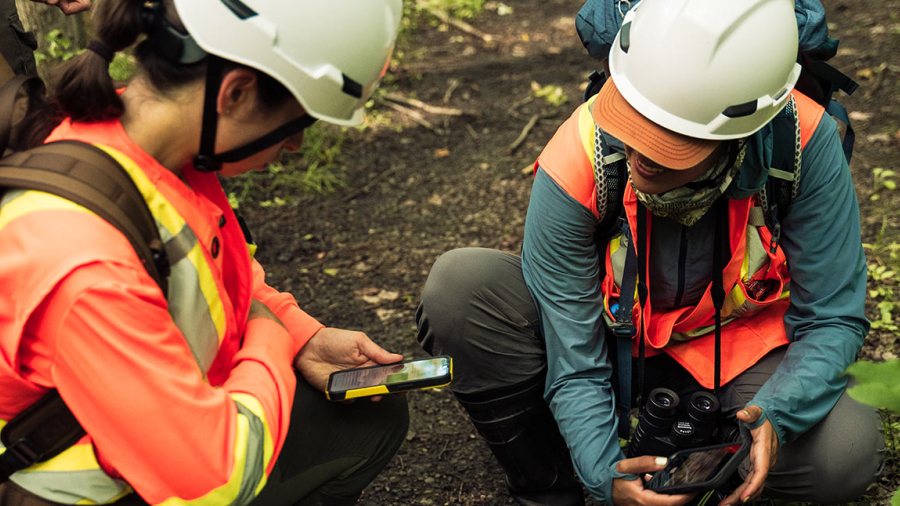
While our engineers and operations team work on the technical aspects of building a railway, our scientists and environmental engineers are out in the field, growing their knowledge about the land and communities. Avoidance begins in the early stages of project design before construction begins. Field studies, public consultations, collaboration with governments, and the contribution of Indigenous knowledge all inform project decisions. By gathering critical information as early in the planning phase as possible, we can make informed decisions about location, methods, and timing to help identify and limit impacts at the source.
Determining the final route is not based on a single factor, but on the careful evaluation of numerous environmental, technical, social and operational considerations.
During our route planning, typical environmental considerations include avoiding sensitive water bodies, wetlands, and critical habitats, minimizing the number of crossings (e.g., of watercourses), favouring already disturbed areas and corridors near existing infrastructure, and reducing proximity to residential areas and community spaces. For example, we will aim to avoid, wherever possible, a river valley with high ecological value, and plan construction outside of sensitive periods such as fish spawning or wildlife migration.
Mitigating Impacts
When impacts cannot be avoided despite our best efforts, mitigation measures are implemented to reduce the intensity, extent, or duration of their effects. Throughout the construction and operations phases, environmental protection measures will be monitored and adjusted as necessary to maintain their effectiveness.
A few typical mitigation examples for major infrastructure projects would include erosion and sediment control fencing, noise walls, spraying water for dust suppression, and site restoration as needed, among others.
Compensating for Impacts
Finally, if residual impacts remain that could not be avoided or mitigated, compensation measures will be implemented where required by applicable environmental legislation. This is our last and least preferred option and does not replace the priority given to avoidance and mitigation.
Examples of compensation measures may include restoring or creating new habitats, improving or enhancing natural or recreational spaces in human environments. We might also opt for restoring environments or enhancing ecological functions elsewhere in the watershed or beyond the project footprint.
Our long-term commitment
Alto’s avoid, mitigate, and compensate approach will act as our guide to integrate the project into the environment while minimizing impacts on natural and human communities.
As the project advances, it will be subject to a federal impact assessment, a rigorous and independent process that evaluates potential environmental and socioeconomic effects, includes consultations with Indigenous Peoples and stakeholders, and determines the conditions under which the project may proceed.
Environmental stewardship does not end once a project is approved or constructed. Long-term monitoring programs will be implemented to evaluate the effectiveness of mitigation and compensation measures over time and adjust them as needed. Through careful planning, ongoing collaboration, and continuous monitoring, we aim to maximize the project's benefits while minimizing its impacts.
Learn more about our environmental approach here.
Share this blog post
Subscribe to the blog RSS feed