Published on October 20, 2026
At Alto, we know that all forms of public transportation generate some level of noise and vibrations, and high-speed rail is no exception. Alto’s high-speed rail is planned to operate on primarily dedicated, fully electrified and grade-separated railway. To reach speeds of 300km/h or more requires a smooth track, with long, straight segments and gentle curves. For passengers, high-speed rail is experienced as a smooth and comfortable ride.
Of course, residents living in proximity can still expect certain levels of noise and vibrations. From design to operation, we are researching and considering how our trains might impact the communities and environments along the train route with a strong focus on minimizing potential impacts.
Measuring baselines to help determine impacts
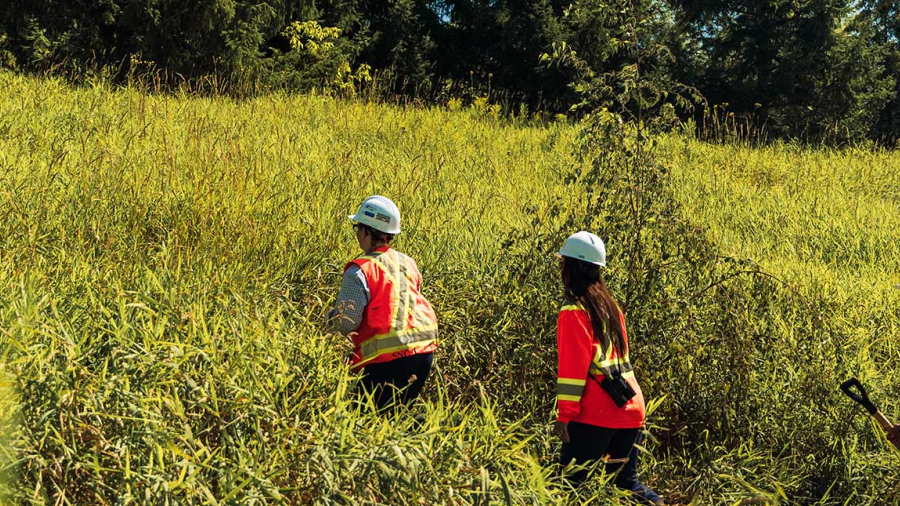
To measure potential noise levels, one of the first points of focus is to determine a baseline. That’s why Alto is beginning by measuring the current levels of sound and vibrations along our study corridor. As part of this work, particular consideration is given to areas where people may be more sensitive to noise and vibration, such as homes, hospitals, schools, daycare centres and seniors' residences. Ongoing field studies are helping establish current noise levels, with more data collection planned as route options are refined.
This baseline will give engineers and environmental specialists a clearer understanding of how future construction or operations could impact local conditions, and where mitigation measures may be needed. Right from the start, Alto and Cadence have been working together, drawing on expertise from across the project's engineering teams, to integrate these potential noise limiting solutions into the project design.

How we measure sound and vibration levels
To establish baseline sound conditions, sound monitoring equipment may be installed to capture surrounding sound levels over a 48-hour period. This equipment typically includes a sound level meter and a microphone mounted on a tripod.
Alongside sound monitoring, vibration monitoring equipment may also be used to measure vibrations from existing train traffic. These instruments are typically positioned or secured at ground level to measure how vibrations move through the ground.
In cases where access to private property is required, Alto will seek permission from property owners before installing monitoring equipment or conducting any related work.
What might cause noise and vibrations
Over the course of the project, the cause of noise and vibrations will shift. Once we enter the building phase, construction activities will cause some disruption, which can vary depending on location and landscape. Though it’s not yet possible to define noise or vibration levels, understanding existing conditions helps Alto identify where mitigation measures may be needed as planning progresses.
Following construction, noise and vibrations are caused by train operations including wheel-to-rail contact, electric motors, air movement and station systems.
At this stage, we do not know the exact impacts, since the railway alignment has not been selected. Noise and vibration levels will depend on many factors including distance from the train route, surrounding noise, terrain, existing structures, and sensitivity of nearby areas.
Factors that influence high-speed rail noise
Alto’s trains will be fully electric, and the railway will be grade-separated, which both have a direct influence on noise levels. First, electric propulsion systems generally produce less noise than diesel locomotives because they do not rely on onboard combustion engines. Meanwhile, grade-separated tracks eliminate road and pedestrian crossings (we will use overpasses and underpasses), which can reduce situations where train horns are required.
Other elements, such as train speed, will also affect noise levels. For example, when entering a city, the train would be travelling more slowly, which reduces noise levels.
Working with communities
Alto is also committed to open, ongoing collaboration with local communities. By listening to concerns early and throughout the design process and as route options continue to be refined, our team aims to identify potential impacts and address them thoughtfully throughout the process from project design to operations.
How we can reduce and limit noise and vibrations
There are many ways to help manage noise and vibrations associated with rail infrastructure. Depending on local conditions, potential measures could include continuously welded rail, sound barriers, specialized vibration control systems, construction management practices, station systems and other design refinements tailored to specific locations. Alto will work to meet or exceed applicable regulatory requirements for noise and vibration.
The purpose of studying noise and vibration early is not simply to collect data. It is to better understand existing conditions, anticipate potential concerns, and identify opportunities to reduce impacts before construction and operation begin.
Share this blog post
Subscribe to the blog RSS feed