Published on September 28, 2026
Updated on September 29, 2026
Alto’s current estimate to build Canada’s first high-speed railway is between $60 and $90 billion. That figure naturally raises questions about cost. But unlike other infrastructure projects, Alto will be a revenue-generating asset.
To understand Alto's estimated cost, it is important to understand how infrastructure costs are categorized, what our estimate is measuring, and how revenues fit into the overall picture. Let's break it down.
Different costs, different purposes
Long-term sustainable infrastructure project cost can be divided into two main categories in terms of cost. They are:
- Capital costs: This represents the investment required to build the infrastructure. For Alto, that includes approximately 1,000km of dedicated, grade-separated tracks and all surrounding structures such as over and underpasses, fencing, train stations, and all other physical assets.
- Operating and maintenance costs: This represents the ongoing costs required to run and maintain the infrastructure once it is in service. For Alto, this includes on and off-train employees, electricity (Alto will be mostly electrified), maintenance, inspections and the ongoing upkeep of the tracks and assets, among other costs.
A useful example to help understand these different costs would be building a home. The investment needed to design and construct the house would be the capital cost. Operating and maintenance costs would include property taxes, electrical bills, house upkeep, and repairs.
Building a new railway begins with capital investment
Every infrastructure project begins with the capital cost: the investment required to build the assets. Before construction even begins, however, significant work is required to develop the project, including engineering studies, environmental assessments, public engagement and design among more important steps before construction begins.
Alto’s current estimate of $60–$90 billion is a preliminary working assumption of the capital cost to build the complete high-speed rail system. Our estimates are prepared during the earliest stages of project development, when the overall concept, route , and scope are known, but many engineering details have not yet been finalized.
Given that the project is still in its initial stages, it is not possible to have a finalized budget. However, we do have partners with international expertise, know-how, and experience to draw on. Our cost estimates will become more precise as the project definition becomes more precise.
When will Alto have a more accurate estimate?
As we advance further with the project, more details will be firmed up, and our cost estimates will become more concrete. Through the design phase, we will confirm the final rail alignment and station requirements. We will also define the infrastructure needed to support the network, including bridges, underpasses, and other structural elements. Lastly, we will have a clearer picture of the quantities of materials needed to build, and market and procurement information. In short, further development of our project will give us the information needed to refine the capital costs.
Why Alto is different: passenger revenue
Alto will be a revenue generating project. Once in operation, we expect to welcome millions of passengers per year. This revenue is projected to fully cover and likely exceed our operating and maintenance costs, according to our research (read more in our report, Canada’s Moment). Furthermore, based on examples of high-speed rail across the globe, it is possible that operating services will generate surpluses. To be clear, these amounts do not cover the original capital costs or all lifecycle costs, but the benefits of building high-speed rail in Canada are well worth those investments.
How Alto compares internationally
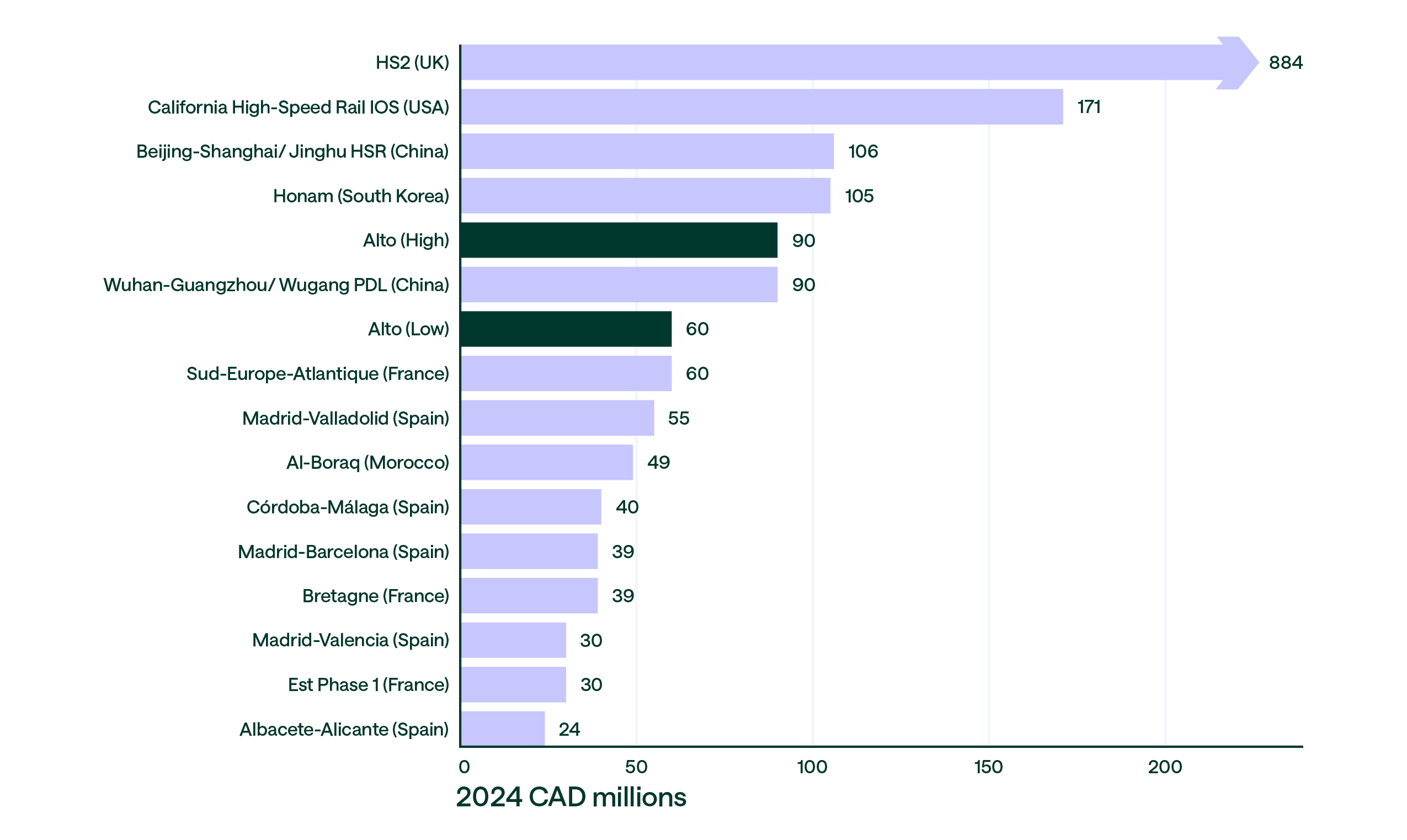
Alto’s current estimate can also be viewed in an international context. As outlined in our report, Canada's Moment our capital cost is approximately $60 million to $90 million per route-kilometre, which is comparable to the international average of approximately $77 million per kilometre for high-speed rail projects. We know that this comparison varies according to factors including geography, land acquisition, labour costs, regulations, and project scope, but it still provides useful context for understanding the estimate available today.
Comparative capital cost recent international high-speed rail projects route-km
Building a high-speed rail network is a long-term undertaking, and the costs will evolve over time, from capital to operation and maintenance costs. As Alto moves into its next phase of development, our focus will be on turning concepts into defined plans through engineering, environmental work, risk analysis, and delivery planning. The result will be a clearer understanding of what is required to build the project, a more detailed picture of how it will be delivered, and a more refined financial framework based on increasingly precise information.
To learn more about how Alto is being developed, explore our report:
Share this blog post
Subscribe to the blog RSS feed