Published on September 10, 2026
Updated on September 11, 2026
Alto’s high-speed rail project is expected to reduce travel times between cities from Toronto to Québec City by nearly half when compared to other modes of transportation. Toronto to Montréal, for example, will take about three hours. This unprecedented journey time will without a doubt change how people travel, but it will also have much deeper economic impacts.
By dramatically improving connections to communities between Toronto and Québec City, Alto has the potential to transform the corridor from a collection of individual cities into a more integrated economic region. High-speed rail will reduce ‘economic distance’, making it easier for businesses to access talent and customers, and increase opportunities for growth.
The opportunity is particularly significant because the Toronto-Québec City corridor is already Canada's largest economic region, home to approximately 17 million people and generating roughly 40% of the country's GDP. Economic modelling suggests that, once fully operational, Alto could contribute up to $24.5 billion in additional annual GDP, helping the corridor function more effectively as a single economic ecosystem.
Alto: the backbone of mobility along the corridor
Improving the transit system is a priority for all major urban centres as our population grows and our travel needs increase. Currently, over $90 billion is being invested in rail-related and rapid-transit projects within the cities of Toronto, Ottawa, Montréal and Québec City, meaning that getting around each individual city will be easier for residents and visitors. However, like any transportation network, the benefits grow when individual systems connect and work together rather than operating as separate islands.
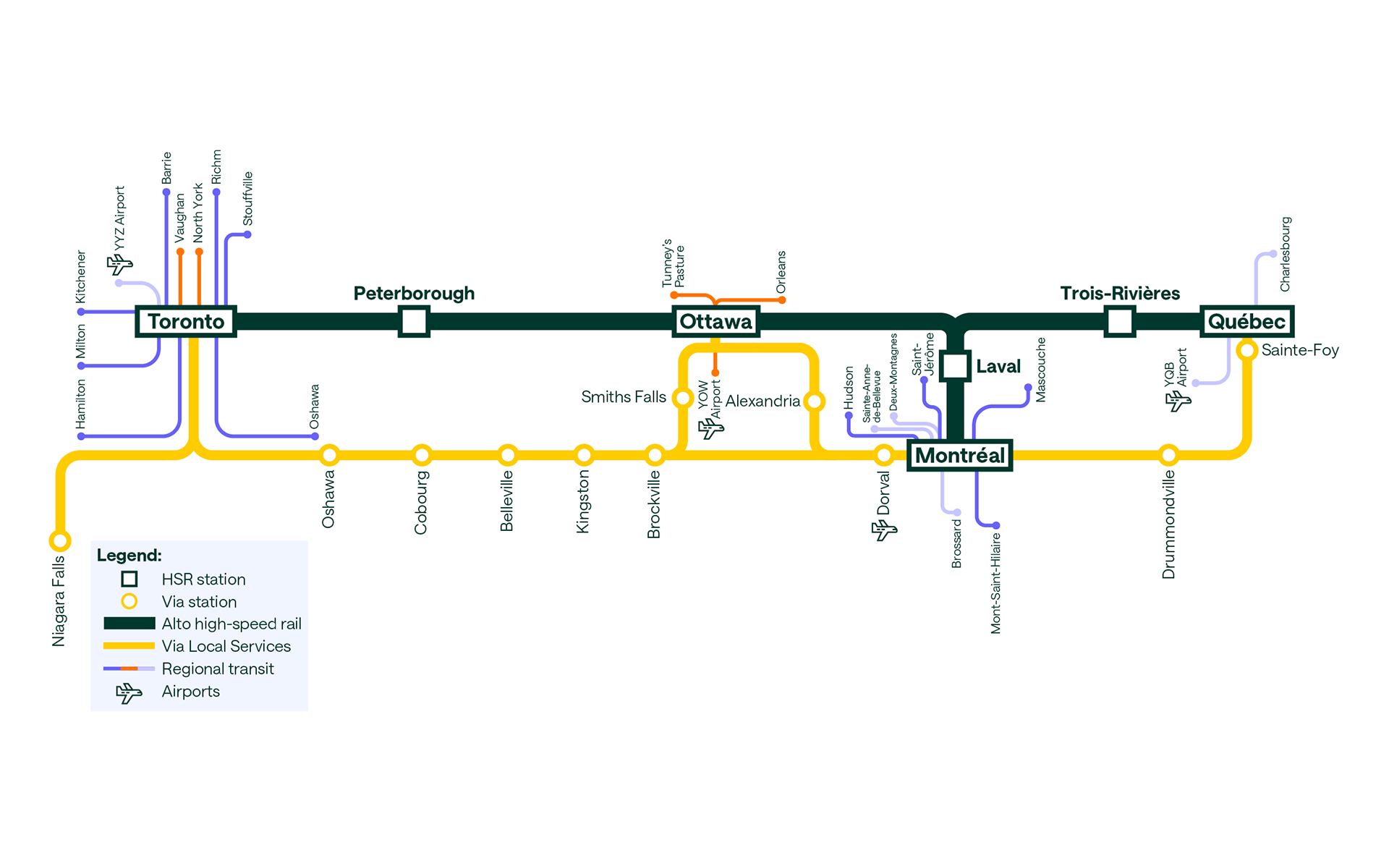
This is where Alto will come in. Acting as the backbone connecting individual transit systems to other cities across the corridor through fast, frequent and reliable high-speed rail service, Alto will help build a larger economic network.
Imagine travelling from Orléans to an important meeting in Montréal using local transit, Alto and the Montréal metro in one seamless journey. What might once have required significant planning could become a practical same-day trip, making it easier for people and businesses to connect across the corridor.
Benefits beyond the station
The reach of economic activity goes far beyond municipal boundaries. When Alto’s service is integrated with regional transit networks, smaller communities can gain easier access to jobs, institutions, and services in larger cities. People living outside larger urban areas would also benefit by being able to seek specialized medical services, attend a training program, or pursue new professional opportunities.
International experience shows that communities connected to high-speed rail have experienced measurable economic benefits. In Germany, counties gaining access to high-speed rail stations recorded GDP gains of approximately 8.5% over six years, while studies in Italy and Spain found improvements in regional productivity and business activity.
Along the Alto line, the communities of Peterborough and Trois-Rivières, for example, will have stronger connections to larger economic centres. Residents, businesses, and institutions will be able to participate in a wider range of opportunities while continuing to strengthen their own local economies. For a small business owner in Trois-Rivières, stronger connections could mean reaching customers in Montréal more easily. For a student in Peterborough, it could mean accessing educational or professional opportunities elsewhere in the corridor without needing to move. These individual connections may seem small, but together they help create a more integrated economic region.
Alto as one part of a larger system
The scale of these benefits will vary across the corridor, but the principle remains the same: the stronger regional connections become, the more opportunities communities have to participate in a larger economic ecosystem.
This is why Alto is not intended to operate as a standalone transportation system. Its greater value comes from strengthening connections across the broader transportation network, helping people and opportunities move more easily between communities.
High-speed rail is about more than faster travel. Its larger value lies in making it easier for people, businesses, and institutions to connect with opportunities that already exist across the corridor. By reducing economic distance and strengthening links across the transportation network, Alto has the potential to help the Toronto-Québec City corridor function more as one integrated economic region, creating new possibilities for growth, collaboration and opportunity along the way.
Integration of high-speed rail with regional and local transportation networks
Share this blog post
Subscribe to the blog RSS feed