
From the earliest stages, Alto is designing the network with the people and communities who live nearby in mind. Preserving local mobility and ensuring safe, reliable connections across the future high-speed rail network are key considerations shaping how it is planned and developed, so that everyday travel, services and community life can continue smoothly alongside the future infrastructure.
In order to meet the highest safety standards, high-speed rail must operate on fenced tracks with no level crossings. That’s why we will build grade-separated crossings, such as overpasses and underpasses, to allow people, vehicles, animals, and equipment to safely move across the tracks.
Once a route is defined, we will work more closely with host communities to integrate the network into its surroundings. This means:
Providing safe crossings
For vehicles, cyclists, and pedestrians through overpasses or underpasses according to local conditions.
Building crossings in rural areas
To support agricultural activities, which will be adapted to large equipment used by surrounding farmers, for example.
Preserving access for emergency vehicles
Ensuring response times and routes remain compliant with applicable safety and operational standards.
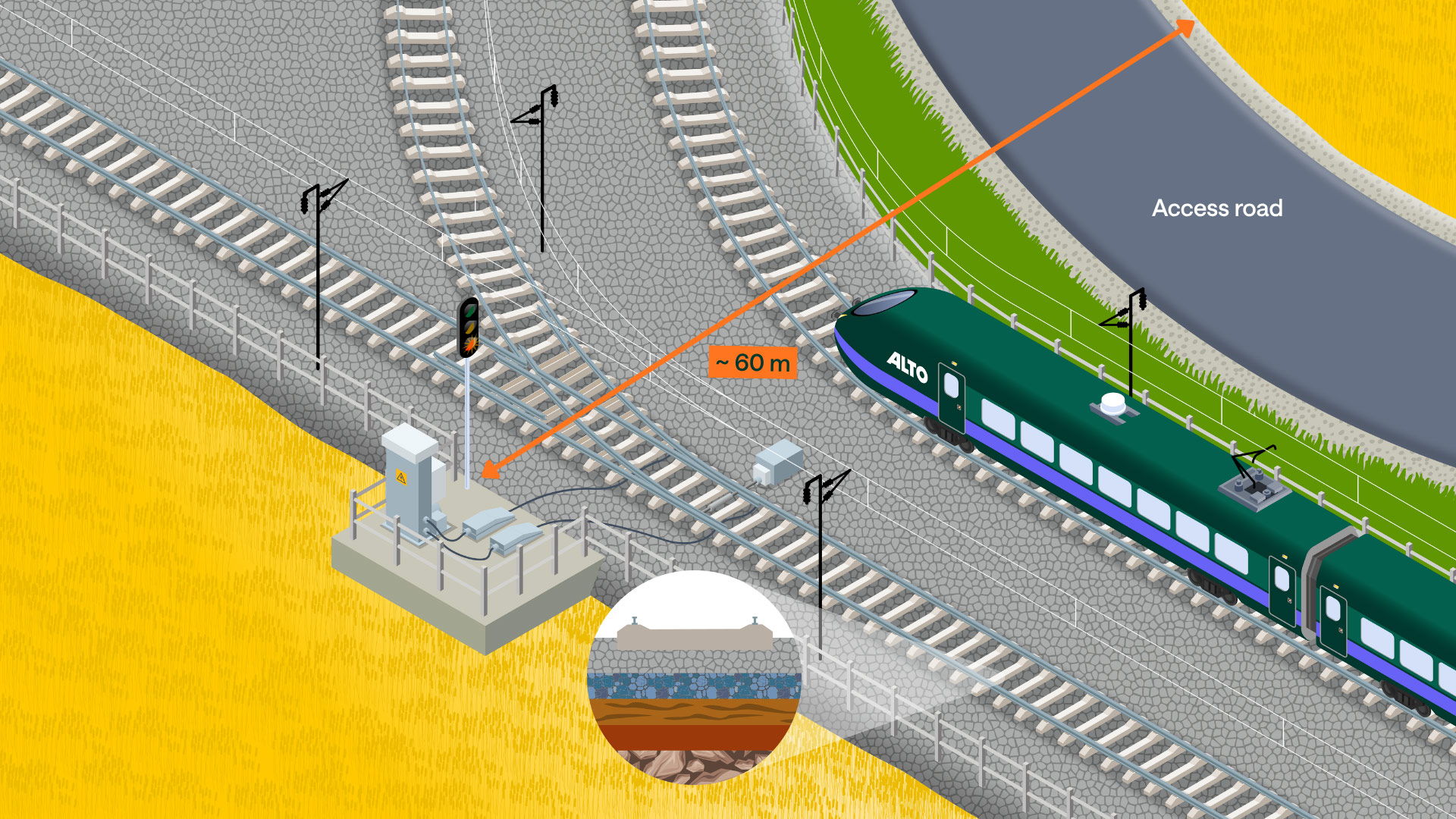
Exploring future uses of access roads
Access roads built outside the fenced tracks could, where appropriate, be used to support agricultural activities.
Our approach to road connectivity, by road type
- Federal and provincial roads will be maintained through an overpass or an underpass, unless exceptional circumstances apply.
- Roads classified as major will be maintained.
- Other municipal roads will be assessed through traffic studies to determine how circulation can be safely and reliably maintained. These studies will reflect how the roads are used every day and will consider their role in local mobility, emergency services, and the movement of goods.
- When traffic levels are high and detours would significantly increase travel time, priority will be given to maintaining a direct connection.
- Where agricultural land is divided by the future tracks, overpasses or underpasses could be designed to support the continued operation of its activities. They will consider equipment width, clearance height, turning space, and frequency of access.
- Their exact location, spacing between road crossings, and design will be identified with input from property owners, agricultural associations, and municipalities. Additional crossings may require additional land, and agricultural realities can vary significantly by region and by type of farming. Recognizing that every situation is unique, solutions will be developed together, based on local realities and priorities.
- Where agricultural land access relies on municipal roads or infrastructure, roadway design, closures, or realignments will also be coordinated with municipalities.
- The access roads to be built outside the fenced tracks could be used to ensure nearby property owners maintain access to their properties while also supporting Alto’s maintenance and operations needs.